What if you could actually enjoy your holiday cookies without your phone buzzing with “quick questions” from clients who forgot you’re human?
I’ve watched business owner friends literally hide from their family at Christmas dinner to answer a client email.
Their excuse? “I never told them I’d be taking time off, so I can’t just ignore them now.”
Wrong. So wrong.
Pro tip: You’re allowed to take time off.
Who knew, right??
But your clients aren’t mind readers, and “I’ll be spending time with family” doesn’t automatically translate to “please don’t email me seventeen times about that thing that can definitely wait until January.”
The Client Communication Fail
It’s December 20th. You’re planning to take the week between Christmas and New Year’s off, but you haven’t mentioned this to clients because you kept thinking you’d “send something out soon.”
Now it’s basically too late to give proper notice, you’re feeling guilty, and you’re convinced at least three clients are going to freak out.
So you do what every overwhelmed business owner does: you just… don’t say anything.
You keep your phone nearby during holiday dinner, check email between present-opening, and tell yourself this is just “part of being a business owner.”
This isn’t dedication.
It’s poor communication disguised as work ethic.
Remember when we talked about avoiding burnout during busy season?
This right here is exactly how burnout starts: blurred boundaries that turn into missed rest that turns into full-blown exhaustion by January.
The Email Template That Actually Works
Here’s the email I send to clients before every holiday break, and it works:
Subject: Holiday Hours and How to Reach Me
Hey [Client Name],
Just a quick heads-up as we head into the holiday season!
I’ll be taking time off from December 20th through January 4th to recharge and spend time with family.
If you need anything before I’m out, please reach out by December 15th and I’ll be happy to knock out any urgent items before then.
I’ll be back in the office on January 5th and will respond to everything in the order it was received.
Thanks for understanding, and I hope you have a wonderful holiday season!
Why this works: It’s specific about dates.
It gives them a deadline for getting things to you.
Plus, it manages expectations about response time.
And most importantly, it’s matter-of-fact, not apologetic.
You’re not asking permission to take time off.
You’re informing them of your schedule.
Handling the “But What If They Need Me?” Panic
Let’s address these fears with coffee in hand:
Fear #1: What if there’s an emergency? Define what actually constitutes an emergency in your business. Website down? Emergency. Want to discuss color options for a March project? Not an emergency.
Fear #2: What if clients get upset? Professional clients understand that business owners take time off. If someone gets genuinely angry that you’re taking a few days for holidays, that’s valuable information about whether they’re a good fit client.
Fear #3: What if they find someone else? Clients who respect your expertise won’t drop you because you took a holiday break. Your boundaries are actually a filter for quality clients.
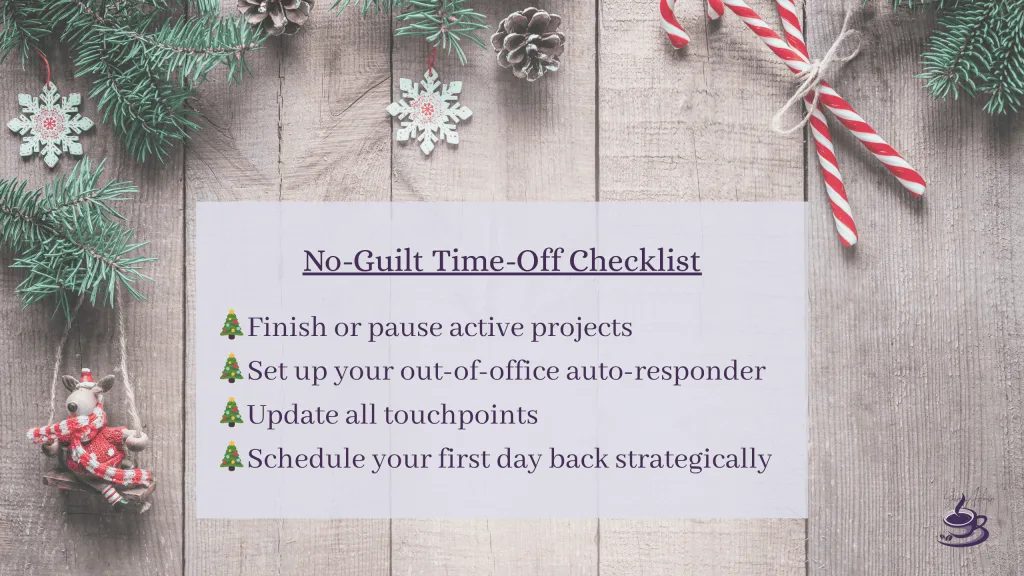
What to Do Before You take time off
Once you’ve sent your communication:
- Finish or pause active projects so nothing is hanging mid-completion.
- Set up your out-of-office auto-responder with your return date.
- Update all touchpoints including voicemail and maybe a social post.
- Schedule your first day back strategically with no client calls so you can catch up.
This is the same principle we’ve talked about before, content batching and systems. A little preparation before your break makes the return so much smoother.
Making This Work Year-Round
Something I’ve learned?
When you get comfortable communicating boundaries during holidays, it becomes easier to set boundaries throughout the year.
Need a long weekend in March? You already have a template.
Taking a summer vacation? Same system.
Building in quarterly planning time? You know how to tell clients you’re unavailable.
The more consistently you communicate your availability, the more your clients come to expect and respect them.
This is part of building sustainable business systems.
Your business should support your life, not consume it.
Your December Action Plan
This week: Draft your holiday availability email using the template above. Send it to all active clients. Set up your out-of-office auto-responder and update your voicemail.
Next week: Finish or pause any active work that would stress you out during your break. Communicate clear timelines for anything resuming in January.
Before you leave: Do a final check of email and voicemail. Then close the laptop and actually enjoy your time off.
Taking care of yourself isn’t optional.
It’s not selfish.
And it’s definitely not unprofessional.
You can’t serve your clients well if you’re running on empty.
Plus, you can’t do great work if you never give your brain a break.
And you certainly can’t build a sustainable business if you never allow yourself to be unavailable.

Send that email, set those boundaries, and actually enjoy your holidays.
Your clients will still be there in January.
Your business will still be running.
And you’ll return refreshed instead of resentful.
That’s the kind of New Year‘s gift that keeps giving long after the decorations come down.