Years ago, I posted about everything. Absolutely no themes to my content.
Productivity tips on Monday. Behind-the-scenes of my day on Tuesday. A motivational quote Wednesday. Client work Thursday. Weekend life Friday.
My content was all over the place. And so were my results.
I’d get engagement on random posts, but nothing consistent.
People would follow me, then unfollow a week later because they couldn’t figure out what I actually did.
I was working my butt off creating content every single day, and my business wasn’t growing.
Then one morning, nursing my second (okay, third) cup of coffee, I was scrolling back through three months of my own posts, and I saw something I’d completely missed.
Every post that actually brought in clients fell into one of three categories.
Everything else? Just noise.
That afternoon shifted my entire approach.
Not because I discovered some secret strategy.
But because I finally looked at what I was already doing and found the pattern hiding in plain sight.
Your content themes are probably already there too. You just haven’t noticed them yet.
Your Phone Already Knows Your Content Themes
Pull out your phone right now and look at how your apps are organized.
Some people put all their social media apps in one folder. Shopping apps in another. Work stuff in a third folder. Random games scattered wherever.
Your content works the same way.
Right now, your posts are like apps scattered all over your home screen. Some in folders, some not, no real system.
Content themes are like deciding which folders you actually need and putting everything where it belongs.
Once you know your folders (themes), every new post has a clear home.
No more “where does this go?” panic every time you create something.
But most people try to create the folders first and then force their apps to fit.
Instead, look at what apps you actually use and create folders that make sense for YOU.
Same with content themes.

The Three-Month Scroll Back
This is how I found mine. And how I help most of my clients find theirs.
Pour yourself some coffee and scroll back through your last three months of content.
Not Instagram Stories.
Your actual posts. Blog posts if you have them. Emails if you send those.
Whatever content you’ve been creating consistently.
Write down what each post was actually about in one or two words.
Not the caption. The topic.
You’ll start seeing repeats. That’s your content talking to you.
For me, it looked like this:
- Batching and content systems (showed up 14 times)
- Finding your authentic voice (showed up 11 times)
- Managing energy and avoiding burnout (showed up 13 times)
- Social media strategy (showed up 12 times)
- Random life updates (showed up 18 times)
- Client stories (showed up 7 times)
Four clear patterns emerged.
And a bunch of random stuff that didn’t really connect to my business.
Those four patterns became my core content areas: what to post (strategy and tactics), what to write about (finding voice and ideas), how to not burn out (self-care and sustainability), and building systems that actually work (processes and efficiency).
The random stuff? I stopped posting it.
Because it wasn’t serving my business.
Now ask yourself: What topics keep showing up in YOUR content?
The Pattern You Can’t Unsee
Once I saw my four core areas, I couldn’t unsee them. Like that first sip of morning coffee that wakes your brain up.
Every client question fell into one of those four buckets. Each post idea I had naturally fit into one category. And every service I offered connected to at least one theme.
So, what changed?
People started understanding what I actually teach.
My content felt cohesive instead of scattered.
My email list grew faster because people knew what they were signing up for.
Discovery calls turned into clients more often because there was no confusion about what I do.
I didn’t change what I talked about, I just stopped talking about the stuff that didn’t fit my themes.
Sometimes the best content strategy isn’t about creating more.
It’s about creating less of what doesn’t matter so what does matter can actually be seen.
Look at your list of topics. Which ones show up most often? Which ones brought in actual business results?
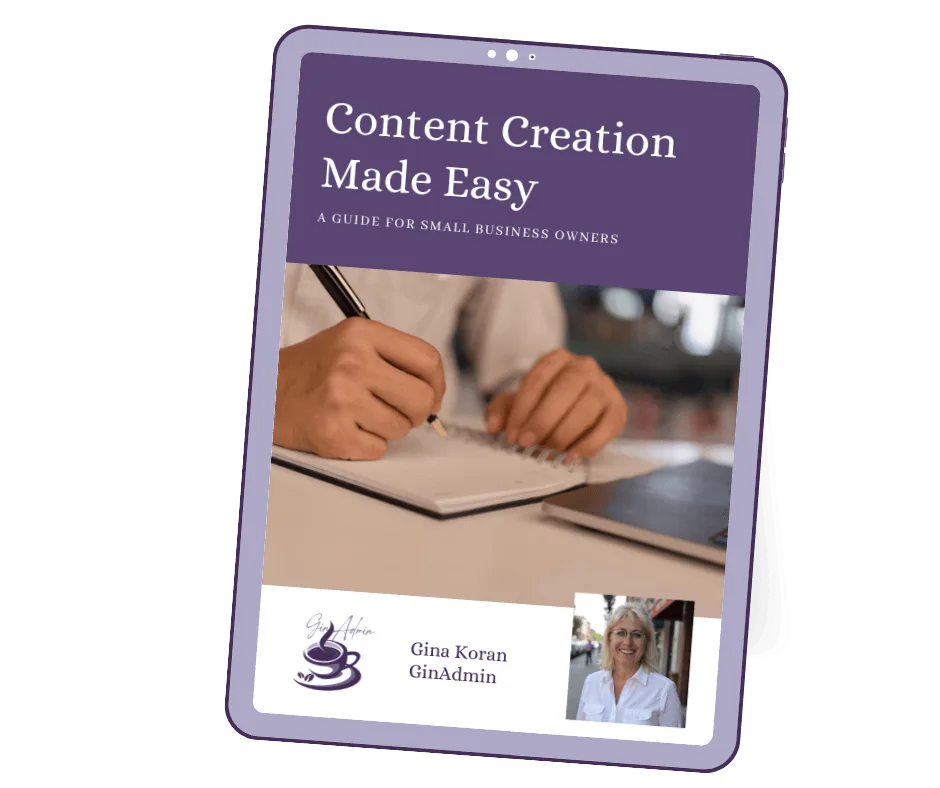
Want help organizing your content ideas once you’ve found your themes? My Content Creation Made Easy Guide has the complete system for turning themes into actual posts without burning out.
When You Have Too Many Themes (Or Think You Don’t Have Any)
Most people land in one of two camps:
Camp 1: Everything is a theme
You look at your three months of content and see ten different topics you’ve posted about.
So you think you need ten themes.
Not quite. Most successful small business owners focus on 2-4 main themes.
Look at your ten topics again. Which ones can be clustered together?
Example: “Time management,” “batching content,” “productivity tips,” and “working efficiently” are all basically the same theme. Call it “Content Efficiency” or “Smart Systems” or whatever feels right.
One theme.
Multiple angles within it.
Your themes should be broad enough to give you room to create but specific enough that people know your lane.
Camp 2: I post about everything randomly
You look back and genuinely don’t see patterns because you’ve been posting randomly, hoping something would stick.
That’s okay.
Start here instead: What do people actually ask you about? Not what you wish they’d ask. What they really ask.
If three different people asked you about the same thing this month, that’s a theme.
Do you find yourself giving the same advice over and over? That’s a theme.
If there’s one problem you solve that makes your eyes light up when talking about it, that’s probably your main theme.
Your business already has themes.
Sometimes we’re just too close to see them.
The Coffee Shop Test for Themes
Before you commit to your themes, run this test: Imagine you’re at a coffee shop. Someone asks what you do. You have about 90 seconds before their latte arrives and the conversation naturally ends.
Can you explain your business using your 2-4 themes in a way that makes sense?
“I help small business owners create a content strategy that sounds like them and doesn’t burn them out.”
That works. It’s clear.
Someone could hear that and immediately know if I’m the right person for them.
“I help with productivity, mindfulness, social media, email marketing, website copy, graphic design, and business coaching.”
That’s… a lot. And confusing. What do you actually specialize in?
Your themes should make it easier for people to understand you, not harder.
Can you explain your business in one sentence using your themes?

What to Do with Content That Doesn’t Fit
You’ll have posts that don’t fit your themes. Everyone does.
Maybe you posted about your weekend. Your dog. A random thought. A trending topic that had nothing to do with your business.
You have three options:
Option 1: Stop posting it. If it doesn’t serve your business, cut it. Save your energy for content that actually brings in clients.
Option 2: Connect it to a theme. Sometimes random content can tie back to your themes with a small shift. A post about your weekend could become a post about rest and boundaries (if that’s one of your themes).
Option 3: Create a “Personal/Life” theme. Some businesses benefit from sharing personal content because it builds connection. If that’s you, make it an actual theme. Not just random life updates, but intentional sharing that serves a purpose.
Whatever you choose, make it intentional.
Random posting by accident feels scattered.
Personal content on purpose feels authentic.
How April Through June Works with Content Themes
You’ve identified your 2-4 themes. Now what?
April: Post about each theme roughly equally. See what happens.
Let’s say you have four themes. You could post about each theme twice a month. Eight posts total (if you’re posting twice a week). Simple.
Watch which theme gets the most engagement. Which one brings in discovery calls or email signups. And which one feels easiest to create content for.
May: Adjust based on April’s data. If Theme A brought in three discovery calls and Themes B and C brought in zero, lean heavier into Theme A for May.
You’re not locked in forever. You’re testing what works.
June: Keep refining. By June, you’ll have a much clearer picture of which themes your audience cares about and which ones you enjoy creating for.
Some themes will naturally become your main focus. Others might become supporting themes you touch on occasionally. That’s normal.
The goal isn’t perfect balance. The goal is knowing your lane.
Where to Write This Down (So You Actually Use It)
Don’t just think about your content themes. Write them down somewhere you’ll see them every time you create content.
I have mine built into my content creation process. Four core areas. Every piece of content fits into one of them.
Every time I sit down to write a blog post or plan social content, I check against my process. Which theme am I writing about today?
Some people put their themes in their content calendar template, while others set them as a note in their phone. And some make them their laptop wallpaper.
It doesn’t matter where. It matters that you see them.
Because three months from now, you’ll be tempted to post about something random that doesn’t fit anywhere.
That sticky note will remind you: does this fit my themes? No? Then skip it.

So, Now What?
Once you know your themes, content planning gets absurdly easier.
You’re not starting from scratch every Monday morning. Instead, you’re picking which theme you’re talking about this week and going from there.
Your content starts building on itself instead of starting over every time.
A post about batching (Theme 1) connects to a post about sustainable systems (Theme 1 again). Your audience sees the connection.
You’ll probably find that you’ve been trying to talk about too many things, and narrowing your focus actually grows your business faster.
Because people don’t hire generalists who do everything.
They hire specialists who are known for something specific.
Your themes are your specialty.
Grab your coffee (top it off if it’s gone cold), scroll back through three months of your content, and find your patterns.
They’re already there. You just have to look.
Brew it and do it!