What if your content could still be bringing in clients three years from now instead of expiring before your coffee gets cold?
Let’s say you created a guide back in 2023.
Nothing fancy. Just answering a question your clients kept asking.
And that guide is still pulling traffic every single month. Still converting. Still working.
Meanwhile, you’re scrolling through your feed watching people absolutely lose their minds trying to figure out which content trends to jump on this week because everything they created last week is already pointless.
Their phone’s notes app is full of expired content ideas and their stress level is through the roof.
Look, there’s just some content that has an expiration date stamped on it the moment you hit publish.
And some doesn’t.
If you’re tired of chasing trends that die faster than your morning coffee gets cold, let’s talk about creating content that actually lasts.
The Content Trends Hamster Wheel
Imagine if you will…Monday morning rolls into town, probably without coffee, and you see new content trends blowing up on Instagram.
By Tuesday, you’ve dropped everything to create content around it.
Wednesday it’s everywhere and you’re feeling pretty good about jumping on it.
Thursday? People are already sick of it.
Friday the trend is dead and your content just… sits there. Pointless.
And Monday morning? You start the whole exhausting cycle over again with whatever content trends are hot now.
Does this feel strategic? Nope.
Is it building anything lasting? Not even a little.
But hey, at least you posted something, right?
This scattered approach to content is killing your productivity and honestly, it’s not even working.
By the time you see content trends and create content around them, you’re already late to the party.
The people getting traction are the ones who either started the trend or jumped on it within the first few hours.
Not the ones who carefully added it to their content calendar three days later.
Meanwhile, you’re spending all your energy creating content with a very short shelf life.
And at the end of every month, what do you have to show for it?
A pile of expired posts you’re kind of embarrassed to leave up.
That’s not content strategy.
That’s a hamster wheel with really bad scenery.

Why Create Content Beyond Trends?
Have you ever thought about what would happen if you created something and it just kept working?
So, for example, let’s say you have a straightforward guide sitting on your site answering a question your clients keep asking.
You wrote it three years ago and mostly forgot about it.
But imagine checking your analytics one day (as one does when avoiding real work OR as a monthly check-in), and that guide is still getting traffic.
Every. Single. Month.
Three years later.
That one guide bringing in more clients than six months of trend-chasing content combined.
That’s the power of evergreen content.
This is what I love about evergreen content: it doesn’t just perform once.
It keeps performing.
Month after month. Year after year.
When you create evergreen content, you’re not just posting something. You’re building an asset.
Think about it like this: chasing content trends is buying coffee every morning at the overpriced place down the street.
Evergreen content is investing in a really good coffee maker that pays for itself and then keeps making you coffee for years.
One pays off continuously. The other costs you every single day.
Plus, evergreen content works better because you’re creating it from a place of strategy, not panic.
Your brain isn’t in “oh, by the coffee gods…I need to post something NOW” mode.
It’s in “let me actually help people” mode.
Big difference.
What Makes Content Evergreen
Okay, this isn’t as complicated as it seems.
Evergreen content answers questions people will still be asking five years from now.
It teaches principles, not tactics tied to whatever platform happens to be popular this week.
It solves problems that don’t disappear when the algorithm changes.
For example:
“How to use Instagram Reels” is trending content. The platform might change. The feature might disappear. The strategy might stop working tomorrow.
“How to tell stories that connect with your audience”? That’s evergreen. People will need that skill forever, regardless of what platform they’re using.
“Five TikTok trends to try this week” expires immediately.
“How to find your brand voice” lasts indefinitely.
See the difference?
Evergreen content focuses on the principles behind the tactics.
The strategy behind the platform.
The skills that transfer no matter what changes in your industry.
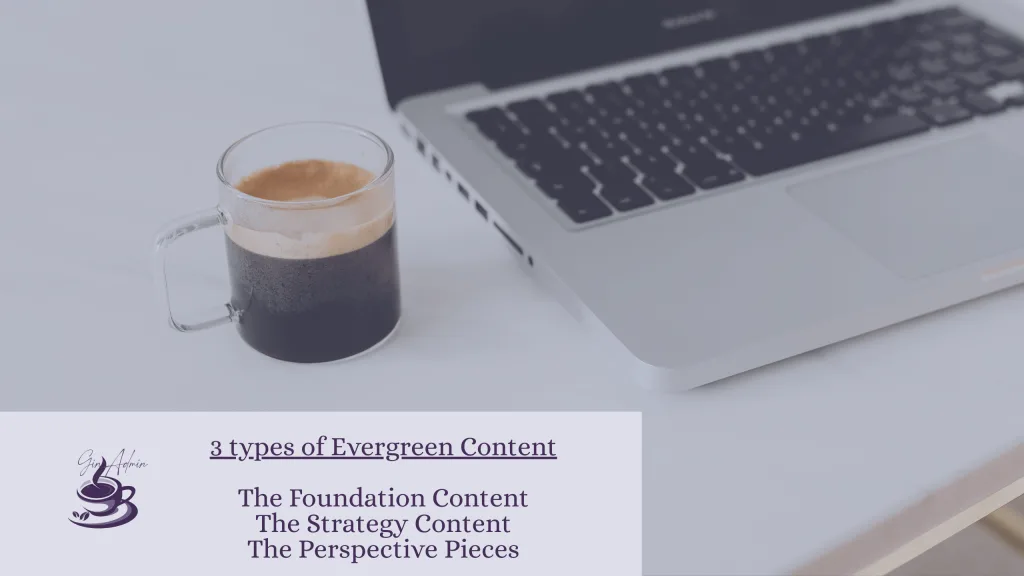
The Three Types of Evergreen Content
Alright, so all that being said…not all evergreen content is created equal.
There are three types, and I honestly believe that you need all three working for your small business.
The Foundation Content
These are your how-to guides, your 101 content, your beginner resources.
They teach fundamental skills or explain core concepts in your industry.
Examples: “How to write a business plan,” “Understanding basic SEO,” “Email marketing for beginners.”
These pieces answer the questions every single person in your industry asks when they’re starting out.
Are they exciting? Not really.
Are they new? Nope.
But they’re necessary.
And they bring consistent traffic because there’s always someone who is starting out, always searching for basics, always needing to learn the fundamentals.
The Strategy Content
These pieces go beyond the basics.
They’re for people who already get the fundamentals and want to go deeper.
Examples: “Building a content strategy that actually scales,” “Advanced email automation workflows,” “Creating a service offer that sells itself.”
This stuff establishes your expertise.
Shows you understand the nuance and complexity, not just the surface-level tips everyone else keeps recycling.
And it keeps people coming back because you’re offering genuine value beyond “here are five quick tips.”
The Perspective Pieces
These are your thought leadership content.
Your takes on industry beliefs; your frameworks for thinking differently; your perspective on why things work the way they do.
Examples: “Why content frequency doesn’t matter as much as you think,” “The problem with hustle culture,” “Rethinking productivity for solopreneurs.”
These pieces don’t teach tactics. They shift mindsets.
And they create real connection because you’re revealing your values and philosophy, not just your knowledge.
Creating Evergreen Content Without Spending Forever
Okay look, you know what evergreen content is.
You get why it matters.
Now how do you actually create it without it taking three times longer than your usual content?
This system is realistic because we’re not talking about writing the encyclopedia here.
We’re talking about strategic content creation that fits into your actual life.
Mine Your Repeated Questions
Start by looking at your DMs. Your client calls. Your consultation notes.
What do people ask you over and over?
Those repeated questions?
That’s your evergreen content garden right there.
Every question you answer more than three times deserves its own piece of content.
And by the coffee gods, don’t overthink this.
Because if three people asked you directly, a hundred more are wondering the same thing and searching for answers online.
Focus on Principles, Not Platforms
When you’re creating evergreen content, think about what stays the same, not what changes.
Don’t write “How to grow your Instagram following.”
Write “How to build an engaged audience” and use Instagram as just one example.
Don’t write “The best AI tools for content creation in 2026.”
Write “How to integrate AI into your content workflow” and mention current tools as examples you can easily update later.
The principle is evergreen. The specific tool isn’t.
This way, when Instagram changes (because it will) or when better AI tools come out (because they will), you’re not rewriting everything.
You’re just swapping out a few examples.
Set Yourself Up for Easy Updates
An important point to remember? Evergreen content is not set-it-and-forget-it forever.
About once a year, you’ll want to review your evergreen pieces and update them.
But make this easy on yourself from the start.
When you create the content, organize it so you can swap out examples without rewriting the whole thing.
Use sections like “Current Tools as of 2026” or “Right Now, These Platforms Work Well” that you can easily update later without touching your core content.
Structure your pieces with principles first, examples second.
That way, when you need to update, you’re just switching out a few specific details instead of rewriting the entire thing.
Way less work. Way more sustainable.
Don’t Overthink the Format
Evergreen content doesn’t have to be some massive 5,000-word ultimate guide.
It can be
- A straightforward blog post.
- A simple video.
- A clear infographic.
- A solid email sequence.
The format matters way less than the substance.
Create it in whatever format works for you and your audience.
Just make sure the content itself has staying power.

The Evergreen Content Test
Want to know if your content idea is actually evergreen?
Ask yourself these questions:
- Will this information still be relevant in three years?
- Is this about a principle or just a platform-specific trick?
- Could someone apply this advice even if their favorite social media platform disappeared tomorrow?
- Am I teaching a skill that transfers or a hack that expires?
- Would this help someone whether they’re starting out today or five years from now?
If you answered yes to most of these, you’re creating evergreen content.
If you answered no, you’re creating trending content.
Which is fine, by the way. Just know which one you’re making so you can plan accordingly.
The 80/20 Rule for Content Trends
Look, I’m not saying never jump on content trends.
Trends help you stay relevant. They show you’re paying attention to your industry. They can create quick wins and bring in new eyeballs.
But the ratio I recommend? 80% evergreen, 20% content trends.
Because trending content brings people in right now.
But evergreen content keeps working for you long after you’ve moved on to creating other things.
Think of it this way:
Trending content is your marketing. It gets attention.
Evergreen content is your sales team. It converts that attention into results. Over and over again.
You need both working together.
But you probably need way more evergreen content than you’re currently creating.
What Happens When You Make the Shift
When business owners make the shift from mostly trending to mostly evergreen content?
Stress levels drop dramatically.
You’re not constantly scrambling to keep up with the latest content trends or what everyone else is doing.
You can create content at your own pace because you’re not racing against trend expiration dates.
You start planning in months instead of days, which feels so much better for your sanity.
Your content library becomes an actual asset instead of a liability.
Instead of a pile of expired posts you’re embarrassed about, you have a collection of resources that keep working.
People discover your old content and it’s still relevant. Still helpful. Still converting.
You can confidently point new clients to pieces you wrote two years ago because they still completely apply.
Your authority builds over time in a way it never can with trending content.
When people can binge your content and it all still works, they trust you more.
They see you’ve been teaching consistent, solid principles over time.
Not just jumping on whatever’s popular this week and hoping it sticks.
And that trust? That’s what actually converts.
How to Repurpose Evergreen Content
The beautiful thing about evergreen content is it keeps giving you opportunities.
One solid evergreen blog post can become a video.
That video can become a podcast episode.
The podcast episode can become an email series.
The email series can become social media posts.
All from one piece of core evergreen content that you created once.
Because the information doesn’t expire, you can keep finding new ways to share it without it feeling repetitive or outdated.
You’re not creating more work from scratch every single time.
You’re making your existing work go further and reach different audiences in different formats.
Way more efficient. Way more sustainable.
The Monthly Evergreen Content Habit
Want to build an evergreen content library without completely overwhelming yourself?
Create one substantial evergreen piece per month.
Just one.
Not three. Not five. One.
Twelve months from now, you’ll have twelve solid pieces of content that keep working for you.
Twenty-four months from now? Twenty-four pieces.
And unlike your trending content from last year that’s all expired and irrelevant now, every single one of these pieces will still be bringing value and converting clients.
One evergreen piece per month.
That’s the habit that changes everything about how your content works for your business.
Your Content Trend Challenge
Here’s what I want you to actually do:
Look at the last ten pieces of content you created.
Seriously, go pull them up right now.
How many of them will still be relevant and useful six months from now?
If the answer is less than five, you’re spending way too much time and energy on chasing content trends that expire.
Now think about the questions people ask you most often in your business.
Pick one. Just one.
Create an evergreen piece of content that answers it thoroughly and strategically.
Not a quick post. Not a trending take.
A real resource. Something you’d be genuinely proud to send to someone three years from now because it’ll still be that useful.
That’s your starting point for building content that lasts.
One solid evergreen piece will keep working long after you publish it and move on with your life.
You can chase trends until you completely burn out.
Or you can build a content library that keeps working whether you’re actively creating new content or taking a much-needed week off.
Trending content is renting attention from platforms and algorithms.
Evergreen content is building equity in your business.
And equity? That’s what creates sustainable, long-term growth.
So pick your one question.
Create your one evergreen piece.
See how different it feels to create something that doesn’t expire the moment the trend dies.
Next time you’re tempted to drop everything and jump on the latest content trend, ask yourself: will this still matter next month?
If the answer is no, maybe it’s time to create something that will still matter next year instead.
Your content library should be an asset that appreciates over time, not a pile of expired attempts at staying relevant.
Start building that asset.
One evergreen piece at a time.
Brew it and do it!
Before you create your next piece of content, ask yourself: will this still matter next year? If you’re not sure what content actually has staying power, grab the Content Audit Checklist. It helps you spot which pieces deserve your time and which ones are just chasing trends that’ll be dead by next week.