Someone, at some point, told you that you need to be everywhere.
Instagram. Facebook. LinkedIn. TikTok. Pinterest. YouTube. Your blog. Your email list.
So you tried. You set up all the accounts. You started creating custom content for every single one. Now you’re completely overwhelmed, most of it gets no engagement anyway, and you keep going because you’re terrified of missing out on the one platform that would have changed everything.
Meanwhile you’re burning out, your content quality is dropping, and you’re doing none of it particularly well.
Grab your coffee. That approach is costing you more than it’s giving you, and there’s a much simpler way.
Why Trying to Be Everywhere Is Actually Hurting You
More platforms sounds like more reach. But that’s only true if you can actually show up well on all of them, and for most small business owners, that’s just not realistic.
When you spread yourself across six platforms, you’re not giving six times the value. You’re giving one-sixth of your energy to each one. Content gets thinner. Consistency disappears. The platforms you actually enjoy using get the same watered-down version as the ones you dread opening.
Platforms reward consistency and quality. Trying to feed six of them at once makes both nearly impossible.
The small business owners who build real audiences online are almost never the ones with the most platforms. They’re the ones who picked two or three and showed up really well on those. Focus wins every time.
We’re about to simplify this considerably.
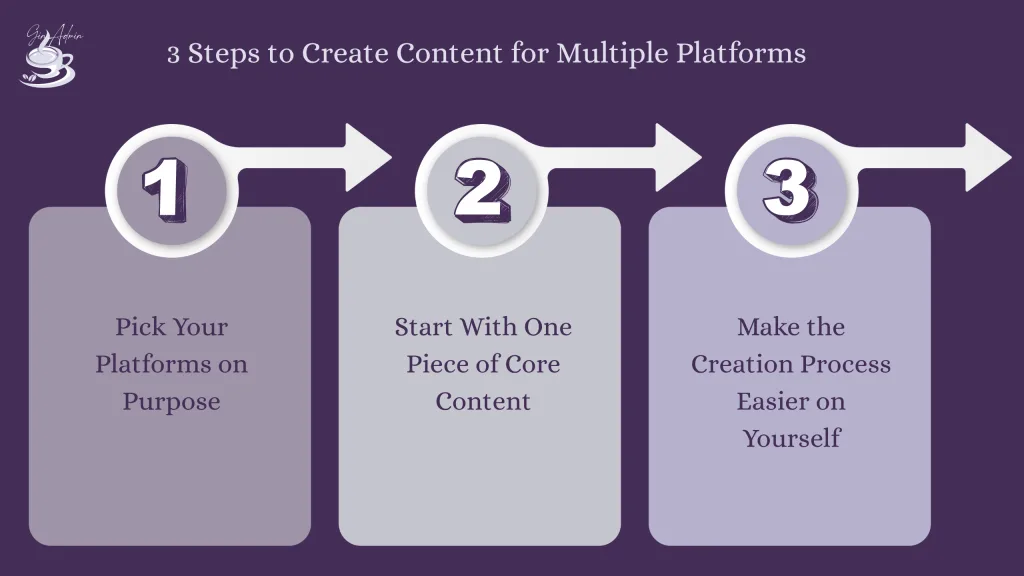
Step 1: Pick Your Platforms on Purpose
Most small business owners end up on platforms by accident. Someone said TikTok was where it’s all happening, so they made an account. A client mentioned they found them on Pinterest, so they started pinning more. Before long they’ve got profiles everywhere and a real strategy nowhere.
Choosing your platforms on purpose starts with two questions.
Where do your ideal clients actually spend time? Not where the gurus say to be, but where the specific people you want to work with are genuinely paying attention.
And where can you show up as yourself? Some small business owners are natural writers. Others are great on video. Some are better in short-form, and still others need a bit more room to explain things well. The platform that works best is almost always the one that fits how you naturally communicate.
Where those two things overlap, that’s your starting platform. Get consistent there first. Then consider adding a second one.
Sit with that over your next cup of coffee. You probably already know the answer.
Step 2: Start With One Piece of Core Content
Once you’ve got your platforms sorted, the next step is to stop creating from scratch for every single one. This is where most small business owners are losing the most time and energy, and honestly, the most coffee-fueled late nights.
The approach that works is building from one piece of core content per week. That one piece becomes the starting point, and everything else flows out from it.
A blog post or a YouTube video works well as that core piece because they give you enough depth to pull from. From that one piece, your email comes out of it. Your social posts come out of it. Your LinkedIn article comes out of it. Everything traces back to that original thinking.
You’re not creating seven pieces of content. You’re creating one and letting it feed the rest.
Each platform gets its own version, adapted for where it’s landing. The email sounds like an email. The Instagram caption sounds like an Instagram caption. Same core idea, different format. Not copy-pasted. Just adapted.
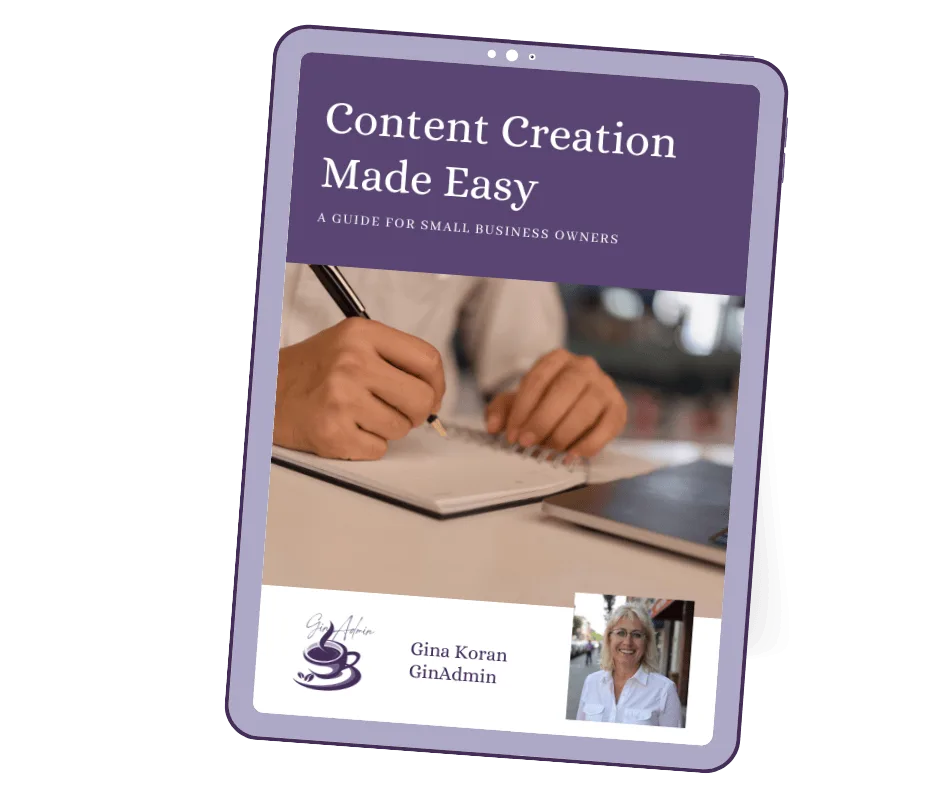
If you want to see exactly how this works in practice, the free Content Creation Made Easy Guide walks you through the 15-Minute Content Batching System, which is built around this exact approach. You sit down once, batch your core ideas, and let them feed your platforms for the week. It’s what makes consistent posting actually doable without eating up your whole evening.
Grab the free Content Creation Made Easy Guide here.
Step 3: Make the Creation Process Easier on Yourself
Knowing what to post is one thing. The part that actually drains small business owners is the daily creation process, especially when it feels like starting from zero every single time. Three things make a real difference here.
Batch your content instead of creating day by day. When you sit down to write one caption, your brain has to warm up, find the idea, write it, and then shut down. Do that five times a week and you’re doing that warm-up five times. Sit down once and batch everything for the week and you do it once. Content gets created faster and it’s usually better too.
Write down ideas the moment they show up, not when you sit down to create. The best content ideas come in the middle of a client call, or while you’re making your second cup of coffee, or on a walk. Keep a running note on your phone. Dump everything in there without editing. That list becomes your content bank and you never stare at a blank page again.
Give yourself permission to be good enough, not perfect. A caption does not need to be a masterpiece. A LinkedIn post does not need to be an essay. Done and consistent beats polished and once in a while, every single time.
One or two platforms chosen on purpose. A single piece of core content per week. Everything else flows out from that.
No complicated calendar, no custom content for every platform, and definitely no posting at 7:04 AM because an algorithm told you to.
Before you write your next post, run it through the Coffee Shop Test. Would you actually say this out loud to a client over coffee? If yes, publish it. If it sounds stiff or like you’re performing for an algorithm, rewrite it in the voice you’d actually use.
More platforms was never the answer. The right two, done consistently and in your own voice, will always do more for your business than six done badly.
Grab your coffee…you’ve got this.